From Parlour Screening to Personal Queue: A Short History of Watching at Home
The history of watching movies at home traces how broadcast schedules, recordings, discs, and streaming changed when households could choose to watch.
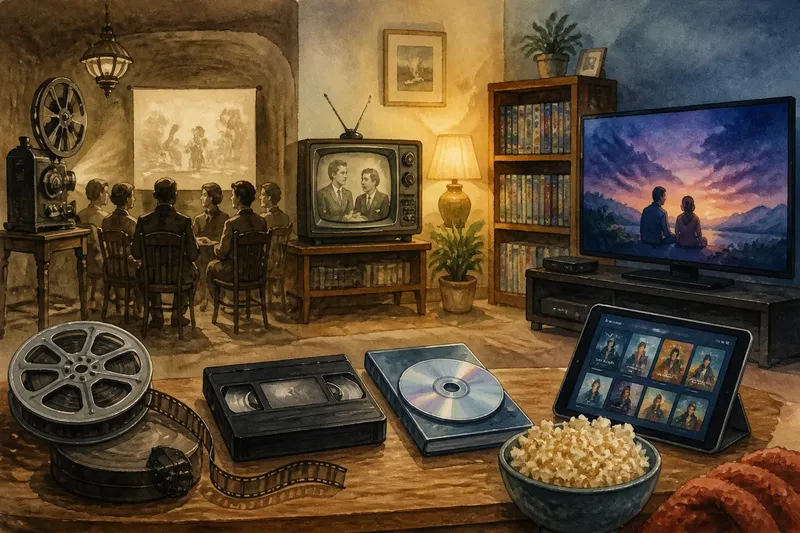
The most common mistake in the history of watching movies at home is to treat each new device as simply a better screen. The more revealing change is control over timing: a broadcast asks viewers to meet its schedule, while a recording or on-demand catalog lets them choose another hour. That shift has been gradual and uneven, not a single moment when every household changed its habits.
Follow the evening rather than the machinery. Someone chooses a film, finds a way to show it, and decides whether to watch alone or with others. Each stage of home viewing has altered those choices, though older habits have often persisted alongside newer ones.
The history of watching movies at home begins with occasional screenings
Early film projection could take place in private homes, but it was not equivalent to switching on a familiar television. A projector, film handling, suitable space, and someone prepared to operate the equipment made a screening an organized event for the people present. Access varied with equipment, resources, and local circumstances, so there was no single household pattern.
A parlour or another room cleared for visitors could serve as a screening space. Chairs faced a screen or a suitable wall; the host arranged the equipment and chose what to show. The preparation helped distinguish the occasion from ordinary time at home, much as setting a table signals that a meal has been planned.
This is a useful starting point because it separates two ideas often bundled together: watching at home and choosing the time. A film could be screened inside a private house while the event still depended on preparation and coordination.
Broadcast schedules made television viewing a shared appointment
Television brought moving images into many living rooms without requiring a projector or a host to prepare a screening. Broadcast television, however, generally offered programs at scheduled times. Viewers could choose among available channels, but seeing a particular film meant fitting the evening around its transmission.
In households that watched together, the living room could become a meeting point. Family members might negotiate what to watch, settle into familiar seats, or treat a particular broadcast as an occasion. These habits differed by household; a shared schedule did not mean everyone watched the same way.
A television film could be interrupted by advertisements, station announcements, or the household’s own distractions, while its sequence remained set by the broadcast. Arriving late meant joining after the story had begun. If another obligation intervened, a viewer might have to leave the film unfinished.
The schedule also created a common reference for people who watched separately. Neighbors or relatives who saw the same broadcast could discuss it afterward, though shared timing alone did not make every viewing a social event.
Recorded video gave viewers a way to move the appointment
Videocassette recorders let households record broadcasts for later, and prerecorded tapes made it possible to select a title without waiting for a particular television showing. The film could be kept on a shelf and played when the household was ready. How common or convenient this became depended on access to equipment and tapes.
Timing became more negotiable, though it still involved small chores. Someone had to select a tape, operate the player, find the right place, and decide whether to watch in one sitting. Rewinding, fast-forwarding, and returning a rental tape were part of the experience.
A recording also changed what it meant to miss a scene. A viewer could pause to answer the door or replay a moment obscured by conversation. Control over pace had entered the room, not just control over the start time.
Say a household has a VCR and records a film airing during a busy evening. On a quieter night, someone puts in the tape, starts the film, and pauses it when a phone call comes; the group can resume from that point rather than accept the broadcast’s ending or miss the scene. The tradeoff is the extra work of recording, locating, and operating the tape.
Disc libraries made choosing a title part of domestic leisure
DVDs and other home-video formats made film collections more visible in some households. A shelf of cases offered a physical menu: titles could be browsed, borrowed, lent, displayed, or saved for a particular mood. The choice shifted from “What is on?” toward “What can we play from this collection?”
Disc menus and chapter selection also made it easier to resume a film, revisit a scene, or select language options and supplemental material. The feature still had a defined beginning and ending, but viewers were less dependent on a television schedule.
Physical media offered continued access to a title while the disc and compatible player remained usable. It also put the collection in the room, where the number of possibilities could outlast the time available for choosing. A disc library changed access, but it did not remove the household negotiation over what to watch.
On-demand services separated access from a shared start time
Streaming and other on-demand services made films available from catalogs without requiring viewers to wait for a broadcast or retrieve a disc. A viewer could start at a convenient moment, pause, and resume later. Access depended on the service, its catalog, the account, and the devices available; it was not the same as owning a physical copy.
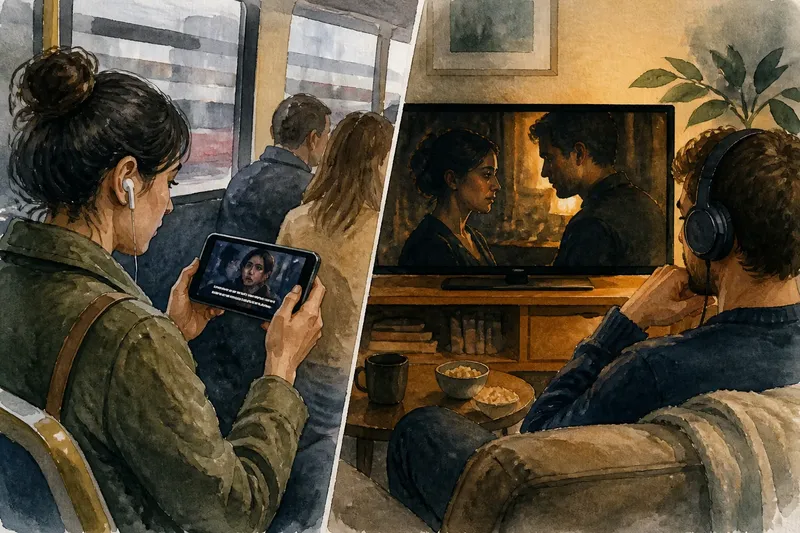
On-demand viewing did not end the social movie night. It made gathering at one time a choice rather than a requirement imposed by a broadcast schedule. The same household could watch together one evening and separately another, depending on its routines and preferences.
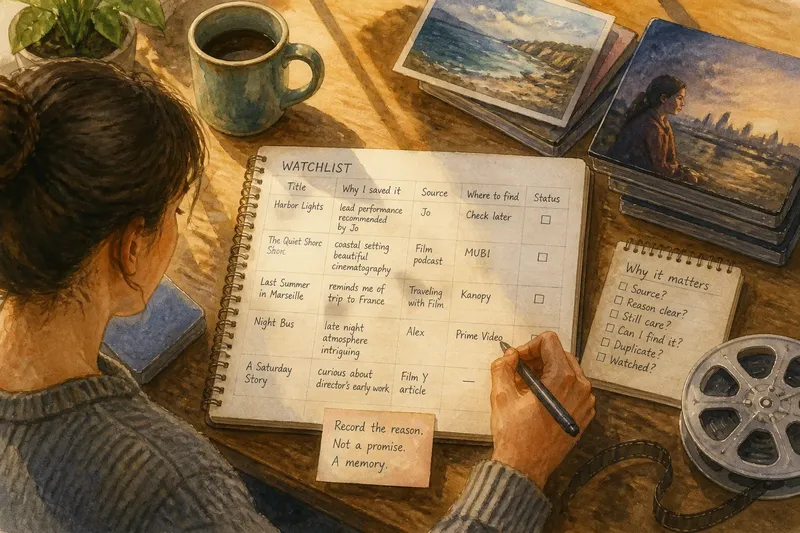
Flexible timing can help a film fit around dinner, a late arrival, or bedtime. It can also make postponement easier: a saved title is a reminder, not an appointment. Separate screens and personal profiles can support individual viewing, while a group can still agree to use one screen and watch together.
Why did home movie nights become less synchronized?
Did television make movie watching flexible?
Television brought films into the home, but broadcast schedules usually set their start times. Viewers could choose among programs, yet a late arrival or missed scene was difficult to correct without a recording.
What changed when households could record programs?
Recording separated the broadcast hour from the viewing hour. Viewers could save a film for later and pause or replay it, with the equipment and tape still requiring attention.
How did streaming change the idea of a movie night?
On-demand access let viewers choose a start time and made separate schedules easier to accommodate. A group screening remained possible, but the group had to choose to gather rather than follow a shared broadcast hour.
Does a personal queue make watching more individual?
A personal queue can support separate viewing because each person can save titles and watch on a different schedule. It can also preserve a shared choice until everyone is ready to sit down together.
Use the history of watching movies at home to plan a fitting evening
The history of watching movies at home points to a practical distinction: decide whether the evening is meant to be a shared appointment or a flexible viewing window. For a shared screening, choose a time people can honor and use one screen. For flexible viewing, agree that pausing or finishing later is part of the plan.
Imagine three friends plan a film after dinner, but one expects a call and another must leave early. They choose a title available on a streaming service, agree to start together, and pause when the call arrives. If the departing friend cannot stay, the others continue and share the ending later; the tradeoff is that the group’s common experience becomes less complete.
- Check whether everyone can be present at the proposed start time. If they can, choose a shared screening; if not, agree to a later time or make separate viewing acceptable.
- Check whether the title is available on the intended service or physical copy. If it is, confirm the playback option; if not, choose another accessible title or change the format.
- Check whether the group wants to pause for interruptions. If yes, agree to pause and resume together; if no, choose a time with fewer expected interruptions or let viewers continue separately.
- Check whether everyone wants the same film. If they agree, begin the shared choice; if they do not, offer a short selection of alternatives or split the evening.
- Check whether a disc, tape, or device is ready to play. If it is ready, start without further setup; if not, use an available format or select a title that works on the prepared device.
- Check whether finishing in one sitting matters to the group. If it does, choose a time with room to watch through; if not, agree where to pause or plan to finish separately.
Home viewing has moved through screenings arranged by a host, scheduled broadcasts, recordings, collections, and on-demand access, with different arrangements continuing to coexist. The screen has changed, but the useful question remains human: is this film for a time you are making together, or for a moment one person can claim when it arrives?