The Watchlist Is Not a Promise: Why More Saved Films Can Mean Less Watching
Organize a film watchlist as a useful record of recommendations, not a queue to clear, so you can preserve why a title mattered without creating pressure.
The common mistake with a film watchlist is assuming every saved title must eventually be watched. That turns a collection of recommendations into a ledger of unfinished commitments, and the list can lose its original purpose: helping you remember what caught your attention.
A better approach treats a film watchlist as a record with context, not a queue. The distinction matters because recommendations fade from memory: you may recall a title but forget who mentioned it, what appealed to you, or why you saved it in the first place.
A film watchlist can preserve context
A saved title without a reason is like a book with its bookmark removed: the object remains, but the place you meant to return to is harder to find. A useful watchlist keeps a trace of the thought behind the save, whether that was a director, a friend’s recommendation, a location, or a particular kind of performance.
This does not require a detailed review. A short note such as “friend recommended the lead performance” or “interested in the coastal setting” gives the title a memory hook. When you revisit the list, you can tell whether that original interest still means something to you.
It also helps to separate remembering from deciding. A long-term collection can preserve titles and their context without asking you to treat every entry as a current candidate. The list becomes useful as personal cultural memory, even if some films never move to a viewing plan.
Choose a record system you will maintain
The right format depends on how much context you want to keep and where you already save films. A streaming service watchlist is convenient, while a notes app or spreadsheet can hold more detail; each option has a different balance of ease and control.
Use a streaming service list for quick saves
This is convenient when you tend to find films while browsing a service. The title and its availability may be close at hand, but the list may not preserve why you saved it, and availability can change. If the reason matters, add a note in a separate place or use a label the service supports.
Use a notes app for brief context
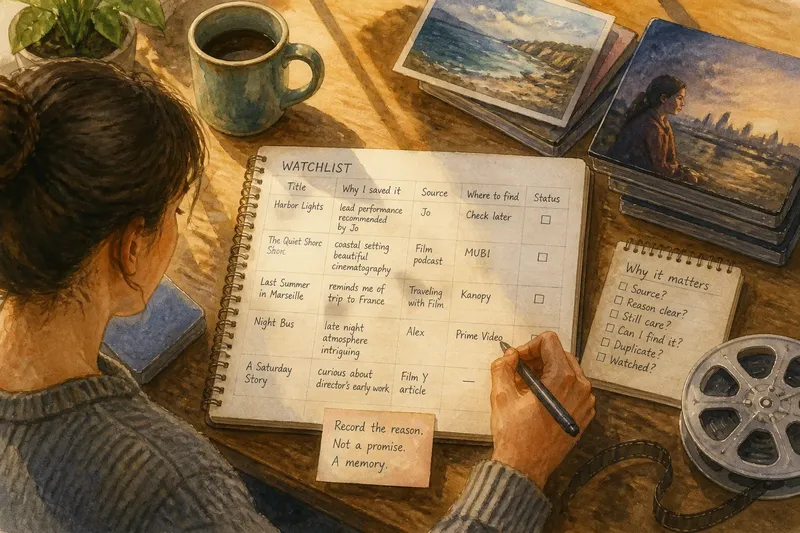
A note can pair each title with a source and a few words about the appeal. For instance, “recommended by Mina; curious about the cinematography” is enough to restore the thought later. The tradeoff is that you may need to check availability separately and update the note if the title becomes hard to find.
Use a spreadsheet for sorting
A spreadsheet can distinguish title, director, recommendation source, reason for saving, and status. That can help if you enjoy filtering by a particular interest, but extra columns only help when you will actually maintain them. Keep the structure as simple as the decisions you want to make.
Which details are worth keeping?
Choose details that answer a question you might have when you encounter the title again. A practical review can use these checks:
- Check whether the title is identifiable; if the entry is ambiguous, add the director or release year, or remove it if you cannot tell what you meant.
- Check whether you remember the source; if a person or publication prompted the save, record that source, or leave it blank if you do not know.
- Check whether the reason for saving is clear; if it is, keep a short note, or mark the interest as uncertain if the reason has faded.
- Check whether you still care about that reason; if you do, retain the entry, or archive or delete it if it no longer matters.
- Check whether you can find the film through a service, library, rental option, or collection you use; if you can, note where, or leave access unspecified and revisit it when choosing.
- Check whether the entry duplicates another one; if it does, merge the notes into one record, or keep both only if they refer to distinct versions.
- Check whether the film is watched already; if it is, move it to a diary or watched list, or retain it in the watchlist only if you have a clear reason to rewatch it.
These checks are not a test of commitment. They help preserve useful information and reveal when an entry has become hard to interpret. You can use the list as a record without making every title a promise.
How should you keep a film watchlist?
Should I keep a film I may never watch?
Keep it if the title or the reason you saved it is still interesting to remember. If it adds no useful context and you do not want the record, remove it rather than treating the save as a debt.
What should I write beside a saved film?
Record the source and the specific appeal in a phrase, such as a director, performance, setting, or recommendation. If you cannot recall the reason, a note that says so is more honest than inventing one later.
Should I use a watchlist or a film diary?
A watchlist records films you might want to see and why they interested you; a diary records what you watched and what stayed with you. Keeping the purposes distinct makes it easier to find either a recommendation or a memory.
What if my saved films keep accumulating?
Decide whether the list is a collection of recommendations or a short set of current options, and label it accordingly. If you want to preserve everything, let the collection remain open-ended and use a separate selection for immediate viewing.
A short example shows how context changes the record
Imagine you have saved Harbor Lights after a friend mentioned its lead performance, but months later you remember only the title. First, you add “recommended by Jo; curious about the lead performance” to the entry. Next, you check whether the film is available through a service, library, or collection you use; if you cannot confirm access, you leave that field blank rather than guessing. Finally, you decide whether the note still interests you: if it does, the title remains a meaningful recommendation; if it does not, you can archive or remove it. The result is a record that explains the save, without implying that watching the film is owed.
When organizing a film watchlist, preserve the details that help you remember your own reasons for saving. Keep the system light enough to maintain, and let a recommendation remain a recommendation unless you deliberately choose to make it a viewing plan.